
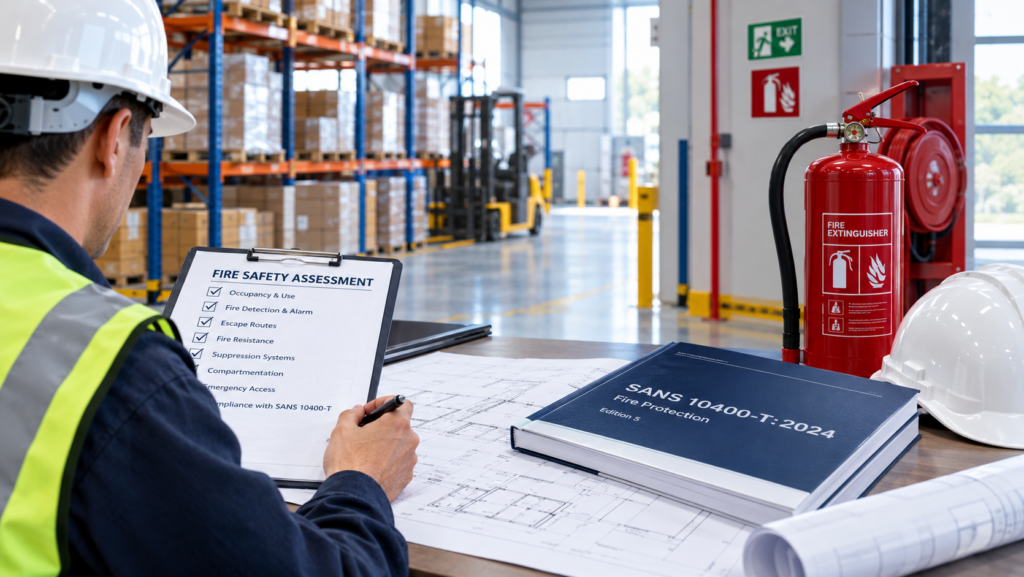
South Africa’s building fire-protection guidance has been updated through SANS 10400-T:2024, Edition 5. The revised standard does not mean that every existing property automatically requires the same upgrade, but it provides a new reference point when buildings are designed, altered, reclassified or reviewed.
The practical effect will depend on the building’s occupancy, size, layout and use. A warehouse, factory or mixed-use property may need to be considered differently if its activities, internal divisions or storage arrangements have changed since its original plans and fire strategy were approved.
Stacking height is one example. Higher or denser storage can alter the nature of the fire challenge and may affect the suitability of escape arrangements, compartmentation, smoke control, firefighting access and sprinkler protection. The updated code should not be read as a universal stacking-height limit. Businesses should instead consider whether present storage arrangements still align with the approved design and any supporting fire-engineering or sprinkler criteria.
Automatic fire detection is another area that may receive closer attention. Published commentary on the 2024 revision notes that the fire-detection provisions are now presented in Table 14 and that the terminology has changed from fire detection to automatic fire detection. Whether a particular building requires an automatic system still depends on its occupancy and the detailed provisions of the standard.
Other matters may become relevant during a review, including occupancy classification, division areas, escape routes, fire resistance, alarm arrangements and the relationship between detection, suppression and evacuation measures. Existing approvals remain important records, but may not reflect later changes in layout, use, stock profile or fire load.
Where operations or storage arrangements have materially changed, property owners and businesses should consider having the current fire strategy reviewed by an appropriately competent fire professional. Recommendations should distinguish between approval requirements, insurer risk-improvement measures and broader good-practice enhancements.
[EDITOR NOTES – Add a short practical example after technical review, such as increased warehouse stacking height or reassessment of automatic fire detection in a mixed-use property.]